Dialogues
The Center for Civic Engagement is excited to offer dialogues that help participants learn, listen, and connect.
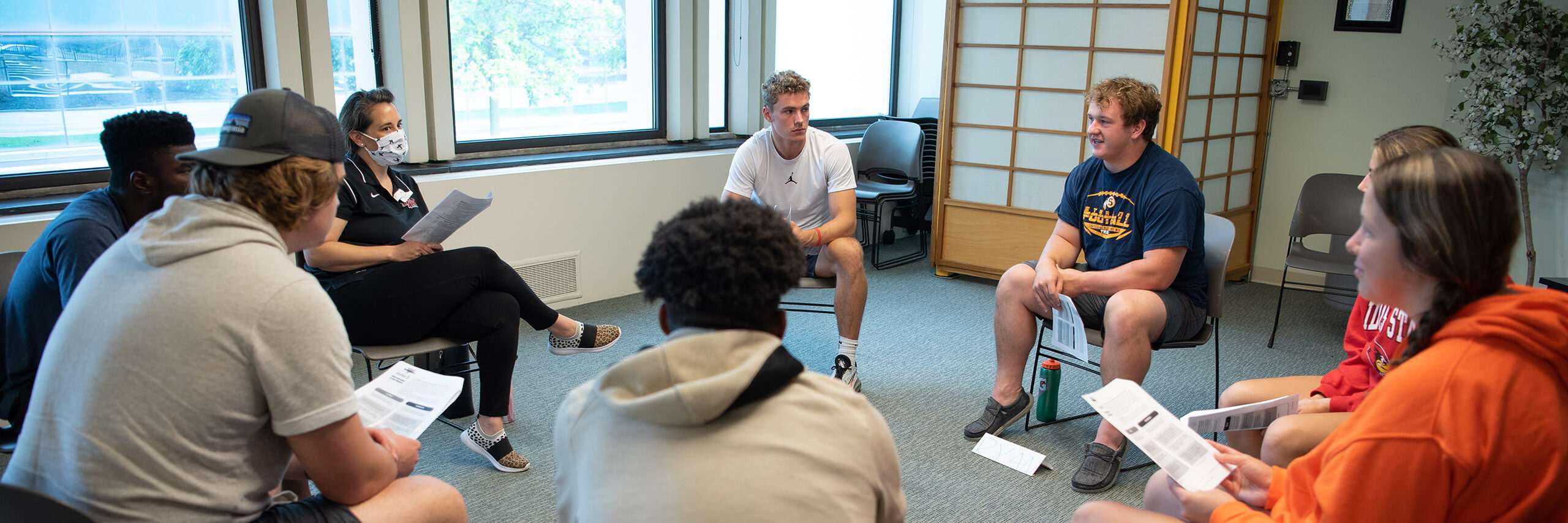
The Center for Civic Engagement (CCE) has proudly offered Dialogue opportunities since 2019 in an effort to "bring people together across divides to tackle today’s toughest challenges." The Center seeks to create space for the Illinois State University community to come together to talk to each other and learn skills related to civil communication and deliberation that promote a thriving and effective democracy.
Do you have questions about Dialogues? Reach out to CCE's Associate Director, Paige Buschmanfor more information!
Living Room Conversations
In the fall of 2026, the Center implemented Living Room Conversations as a form of dialogue programming that can help participants take the first steps toward having difficult conversations. This model creates an opportunity for participants to share their lived experience on a topic to build community by creating trust and promoting active listening, curiosity, authenticity, and respect.
Living Room Conversation Topics
The Center partners directly with the non-profit Living Room Conversations and adapts their model dialogue.
Explore Living Room Conversation Guides
Center staff are still piloting the Living Room Conversations program and may not have extensive expertise with each guide, but are happy to share their experience. If you have any questions about which guide is best for your group, please reach out to CCE's Associate Director, Paige Buschmanfor a consultation.
Learning Outcomes
The Center has identified the following outcomes for Living Room Conversation Participants.
As a result of the Living Room Conversations experience, participants will be will be able to:
- Respond positively to the presence and perspectives of others
- Respond to others’ words by incorporating them into the dialogue
- Articulate the need for an appropriate tone and message when exchanging ideas (oral or written)
- Recognize new and difference perspectives in relation to own personal attitudes, values and/or beliefs
The Center believes that Living Room Style conversations are a foundational form of dialogue that help communities create the understanding and trust that can ultimately lead to more complex problem-solving work.
Deliberative Dialogues
Deliberative Dialogues are guided conversations on a socio-political and sometimes controversial topic. This model of conversation removes polarizing positions and one-sided lectures by asking participants to investigate specific solutions to a complex problem through the help of an issue guide and trained facilitator.
By participating in a Deliberative Dialogue, participants can build empathy, active listening and deliberation skills. Participants can also learn about the value of hearing multiple perspective, learn something new about an issue and consider how to have conversations on difficult and complex topics in the future.
Dialogue topics
The Center uses the National Issues Forums Institute (NIFI) model of deliberative dialogues.
Explore Dialogue topics from NIFI
The Center also uses several dialogue guides that follow NIFI's format, but were developed by Illinois State students on topics NIFI otherwise has not covered. Those topics include:
- Teaching Religion in Public Schools (2026)
- The Housing Crisis in Central Illinois (2025)
Center staff have extensive experience facilitating each issue guide and have found that some guides are more effective than others. If you see a dialogue listed on NIFI's website that is not included in our request form, it is likely that we have assessed that the guide has quality issues. If you have any questions about which guide is best for your group, please reach out to CCE's Associate Director, Paige Buschmanfor a consultation.
Learning Outcomes
The Center has identified the following outcomes for Deliberative Dialogue participants.
As a result of the Deliberation experience, participants will be will be able to:
- Respond positively to the presence and perspectives of others
- Respond to others’ words by incorporating them into the dialogue
- Articulate the need for an appropriate tone and message when exchanging ideas (oral or written)
- Recognize new and difference perspectives in relation to own personal attitudes, values and/or belief
- Examine the complexity of a community or social issue*
- Evaluate options to select the best method to advance a project or solve an issue*
- Examine perspectives and ideas to explore what is, can, or could be*
We believe there are many other possible outcomes to dialogue work and are able to work directly with instructors to craft civic engagement-related outcomes that fit their courses. * Indicates learning outcomes that are specific to deliberation. The Center believes that Living Room Style conversations are a foundational form of dialogue, while deliberations can challenge students to build a greater skill set specific to the problem-solving nature of deliberation.
Requesting a Dialogue
The Center offers its Dialogue program as a free experience to the campus community. Any faculty/staff/student or student group can request a Dialogue. External organizations interested in a facilitated dialogue may reach out to CCE's Associate Director, Paige Buschmanfor a consultation regarding your interest.
A dialogue is optimally 90 minutes long; if you're interested in holding a dialogue for a non-class group, we recommend setting aside this amount of time. A dialogue can also be hosted in a 75 minute class period. Due to an increase in 50 minute course blocks, the Center can offer condensed 50 minute dialogues, though, when possible, we encourage instructors to spread deliberations over two consecutive class periods if possible.
Please submit your request at least three weeks/fifteen business days in advance to allow time for scheduling.
Request a dialogue for your class or organization
Student Dialogue Facilitators
Center staff, student facilitators, and select faculty/staff across campus have been trained to facilitate dialogues. The majority of our dialogues are facilitated by students.
In the fall of 2021, the Center launched the Student Dialogue Facilitator program to help with increased demand for Dialogues across campus. The program also offers leadership and dialogue experience for the student facilitators.
Dialogues are not a permanently funded program and the Center relies on donations to support this program. If you would like to help ensure the future of the Student Dialogue Facilitator program, please consider making a contribution to the Center.