Guide to Political Offices
Federal Offices
US President
The President is both the head of state and head of government of the United States of America, and Commander-in-Chief of the armed forces. Under Article II of the Constitution, the President is responsible for the execution and enforcement of the laws created by Congress. The President appoints members of the President's Cabinet to lead fifteen executive departments which carry out the day-to-day administration of the federal government. They are joined in this by other executive agencies such as the CIA and Environmental Protection Agency, the heads of which are not part of the Cabinet, but who are under the full authority of the President. The President also appoints the heads of more than 50 independent federal commissions, such as the Federal Reserve Board or the Securities and Exchange Commission, as well as federal judges, ambassadors, and other federal offices. The President has the power either to sign legislation into law or to veto bills enacted by Congress, although Congress may override a veto with a two-thirds vote of both houses. The Executive Branch conducts diplomacy with other nations and the President has the power to negotiate and sign treaties, which the Senate ratifies. The President can issue executive orders, which direct executive officers or clarify and further existing laws. The President also has the power to extend pardons and clemencies for federal crimes.
White House information about the Executive Branch of US Government
US Senators
The US Senate is one of two chambers for the federal legislature (Congress). The Constitution grants Congress the sole authority to enact legislation and declare war, the right to confirm or reject many Presidential appointments, and substantial investigative powers. The Senate has several powers assigned exclusively to it, including the power to confirm Presidential appointments, ratify treaties, and try impeachment cases for federal officials. The Vice President of the United States serves as President of the Senate and may cast the deciding vote in the event of a tie. The Senate is composed of 100 Senators, with two members representing each state, and Senators are elected to six-year terms with elections staggered so that only a portion of the Senate is up for reelection every two years. Senators must be at least 30 years of age, a U.S. citizen for at least nine years, and a resident of the state they represent.
White House information about the Legislative Branch of US Government
US House of Representatives
The US House of Representatives is one of two chambers for the federal legislature (Congress). The Constitution grants Congress the sole authority to enact legislation and declare war, the right to confirm or reject many Presidential appointments, and substantial investigative powers. The House has several powers assigned exclusively to it, including the power to initiate revenue bills, impeach federal officials, and elect the President in the case of an Electoral College tie. Members of the House are elected every two years and must be 25 years of age, a U.S. citizen for at least seven years, and a resident of the state (but not necessarily the district) they represent. The House of Representatives is made up of 435 elected members, divided among the 50 states in proportion to their total population.
White House information about the Legislative Branch of US Government
Illinois has a total of 17 representatives. Each representatives has an office in Washington, D.C. and offices throughout their district. Depending on where you live in Bloomington-Normal, you are either represented by District 16 or District 17. Check the House of Representatives website to determine which district you are in.
Illinois State Offices
Governor and Lieutenant Governor of Illinois
The Governor of Illinois is the elected leader responsible for overseeing the state’s executive branch and ensuring effective governance. The governor appoints state officials, signs bills into law, and proposes the state budget. They also serve as Commander-in-Chief of the Illinois National Guard and have the authority to convene special sessions of the state legislature. Additionally, the governor represents Illinois at the national level, advocating for the state’s interests with federal agencies and other states. The governor’s offices are located in Springfield and Chicago.
Governor of Illinois information
The Lieutenant Governor of Illinois is the second-highest elected official in the state's executive branch and the first in line to become governor if the governor is no longer able to serve. They oversee several statewide initiatives, including efforts related to justice reform, rural affairs, economic development, and environmental coordination. By chairing multiple councils and collaborating across agencies, the office helps shape policy implementation and advance the governor's priorities. The Lt. Governor's offices are located in Springfield and Chicago.
Illinois Secretary of State
The Illinois Secretary of State is responsible for keeping the state's official records, laws, and the Great Seal. The office handles everyday services that most Illinois residents rely on, including issuing driver's licenses, state IDs, and vehicle registrations along with overseeing programs that support compliance with driving-related laws.
Illinois Attorney General
The Illinois Attorney General is the chief legal officer of the state of Illinois and is part of the executive branch of state government. The officeholder is elected by voters to a four-year term and is responsible for representing the state in legal matters, providing legal advice to state agencies and officials, and overseeing a wide range of services such as consumer protection, public safety, and victim assistance. The Attorney General also handles legal affairs on behalf of the state and helps enforce laws to protect Illinois residents.
Illinois Treasurer
The Illinois Treasurer is one of the state’s elected executive officials and serves as the chief financial officer of Illinois. The Treasurer is responsible for managing and safeguarding state funds, investing money on behalf of the state, and acting as the state’s bank. The officeholder is elected to a four-year term and oversees programs that support financial security for residents, such as college savings plans and financial education initiatives.
Illinois Comptroller
The Illinois Comptroller is one of the state’s elected executive officials and is responsible for managing the state’s financial records. The Comptroller is elected to a four-year term and oversees the state’s fiscal accounts, ensuring that money is properly tracked and that payments are made and received through the state treasury. The officeholder plays a key role in maintaining financial transparency and accountability in state government.
Illinois Senate
The Illinois Senate is one of two chambers of the state legislature (Illinois General Assembly). Senators are responsible for passing bills into law, approving the state budget, confirming appointments to state departments and agencies, acting on federal constitutional amendments and proposing constitutional amendments for Illinois. It also has the power to override gubernatorial vetoes through a three-fifths majority vote. The Illinois Senate tries impeachments made by the House of Representatives and can convict impeached officers by a two-thirds vote. There is a total of 59 Senators, with each senatorial district representing two of the smaller legislative districts. Your Representative represents you at the state level. They have an office in Springfield (the state capital) and local offices in their district.
Illinois House of Representatives
The Illinois House is one of two chambers of the state legislature (Illinois General Assembly). Representatives are vested with the power to make laws, come up with a state budget, act on federal constitutional amendments, and propose constitutional amendments to the state constitution. The Illinois House of Representatives also holds the power to impeach executive and judicial officials. There is a total of 118 Representatives, one from each individual legislative district. Your Representative represents you at the state level. They have an office in Springfield (the state capital) and a local office in the district.
Illinois State Courts
How does the Illinois court system work?
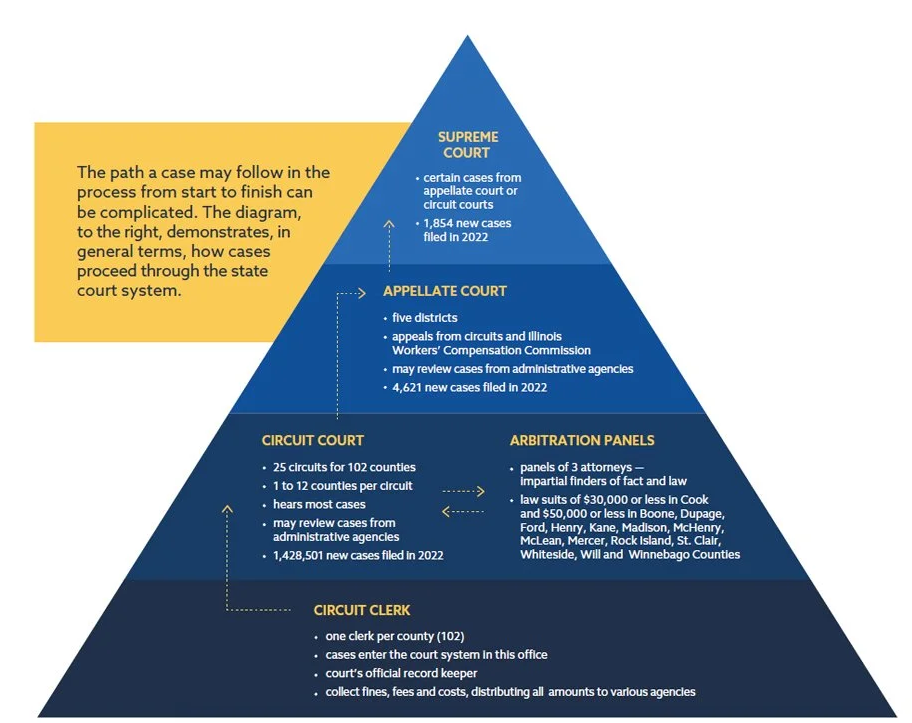
The State of Illinois has three different levels of courts: circuit courts, appellate courts, and the Illinois Supreme Court. The circuit court is a court of original jurisdiction which is divided into twenty-four circuits. Cases are initially filed in the circuit clerk’s office in a county of the circuit (in Bloomington-Normal, this is the McLean County circuit clerk). The case is then heard in the circuit court in which the county is located. Circuit courts may also be referred to as trial courts. Each circuit is located in one of five appellate court districts. McLean County is in the 4th District Appellate Court. Cases may be appealed to the appellate court in the district containing the circuit court, or, in certain circumstances, directly to the Supreme Court. After an appellate court decision, parties to the case may seek discretionary review by the Supreme Court. See the diagram below for a general description of how cases move through the state court system.
Why do we elect judges?
In the voting booth, after making their choices for governor, president, senators, and state reps, voters face another daunting task: voting for judges. Voter participation on this part of the ballot drops off steeply, with about one-quarter of voters not making judicial picks.
Unlike other elected officials, judges in Illinois don’t have to defend themselves against challengers at the end of their six-year terms. Instead, they go up for retention on the general election ballot. Voters choose yes or no to keeping each judge on the bench, and the judge has to get 60% yes votes to stay. There are no term limits.
Illinois is one of just nine states in which circuit court-level judicial candidates run for their first term in partisan elections and one of eight states using the retention voting method when sitting judges run for re-election. Judges in Illinois have been chosen through partisan elections since 1848. The last attempt to change that, during the 1970 Constitutional Convention, failed when voters in a statewide referendum chose by a slim margin to keep the partisan election system over creating a merit-based selection process. (Excerpts from Cook County Judicial Explainer)
Why should I care about who the judges are?
Each day, state court judges shape the country we live in. They interpret the law to resolve disagreements and protect the rights of people in the communities they serve. Judges are involved in many major life events; if you dispute a speeding ticket, sue for damages after a car accident, settle a deceased loved one’s estate, lose a home through eviction or foreclosure, get divorced, or face accusations of committing a crime, among many other circumstances, a judge is involved and will be instrumental in determining the outcome of a court case. Sources: Judicial selection map, excerpts from Cook County Judicial Explainer
McLean County Offices
Auditor
The County Auditor is the officer responsible for examining how all of the other departments are operating, including use of financial resources.
Circuit Clerk
The Clerk of the Circuit Court of McLean County (Circuit Clerk) is, by law, the official keeper of records for all judicial matters brought into the Circuit Court of McLean County. Other duties include gathering and reporting statistical data to various law enforcement and state government bodies, and receiving and disbursing fines, fees, and costs collected as a result of court actions.
County Clerk
The McLean County Clerk is responsible for administering elections (in most of McLean County), maintaining vital records such as birth, death, and marriage certificates, and recording legal and real estate documents. Other duties include managing property tax extensions, processing business services such as licenses and permits, and ensuring that official county records are properly maintained and accessible to the public. (McLean County Clerk’s website)
County Treasurer
The McLean County Treasurer is responsible for overseeing the collection and distribution of property taxes for the county. The Treasurer serves as the county’s chief financial officer, managing the collection of taxes from tens of thousands of properties and distributing those funds to local taxing districts. Other duties include performing key financial operations such as investment management, revenue collection, payroll accounting, and financial reporting, as well as maintaining accurate records of county finances.
Coroner
The McLean County Coroner is responsible for investigating sudden, unexpected, or unattended deaths that occur within the county. The Coroner determines both the cause of death (the medical reason) and the manner of death (the circumstances surrounding it). Other duties include responding to death scenes, working with law enforcement, identifying the deceased, notifying family members, arranging autopsies, and preparing official death records. The Coroner’s Office also provides morgue and autopsy services for other counties when needed.
State’s Attorney
The McLean County State's Attorney's Office is responsible for prosecuting individuals charged with a crime, as well as providing advocacy for community members.
County Sheriff
The McLean County Sheriff oversees law enforcement operations, maintains the county jail, and ensures public safety through policing, corrections, and community partnerships. Other duties include safeguarding the constitutional rights of citizens, responding to emergencies, and working with local and regional agencies to promote a safe and secure community.
County Board
The county board is both the legislative and executive branch of county government. It enacts ordinances and resolutions and administers the activities of county departments. They establish tax rates, authorize bond issues, reviews zoning, planning and land use matters, and considers appeals in granting or denying certain permits and licenses.
County Board Information Sheet
Most Illinois State students are in District 4 or District 6. Find your county board district here.
Precinct Committeepersons
Precinct committeepersons represent their party’s voters within their precinct. Working with their party’s Central Committee, they are the grassroots base for the political party’s activities. They may help their party’s candidates, organize fundraisers, and introduce candidates to voters in their precinct. Precinct committeepersons are usually a good source of information about their party’s candidates. McLean County has over 100 precincts; the precincts listed below include Illinois State University and surrounding areas. You can find all McLean County Precinct Committeepersons Directory here.